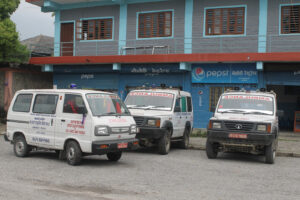
In order to provide emergency services to people living in Pokhara and surrounding rural areas, this organization has been providing ambulance services through Lamachaur Sub-Health Post with the support of the Indian Embassy since 2065 BS. This organization has operated the emergency service with the aim of providing services as soon as possible to the helpless and disabled group who are deprived of easy access to health institutions and have low incomes. While providing services by making maximum use of local resources and facilities, people living in the northern rural areas of Pokhara, such as Lamachaur, Batulechaur, Armala, Purunchaur, Sardikhola, Machhapuchhre, Ghachok, Lahachok, Hemja, which occupy a large geographical area, are in the middle of life and death. This emergency service has been effective in taking them to the health institution quickly. Families with low income sources in the society, helpless and disabled patients and beggars have also benefited from this service. Among the other ambulances in Pokhara, it is very useful and convenient for this area to provide services to the community in the northern area of Pokhara, geographically and in terms of time. Along with the operation of the ambulance, the need for a hearse was felt in this area, and a request was made to the Nepal Chambers of Commerce, Kathmandu, and support was received to provide the service as a Maruti van hearse since 2068 BS. Similarly, the organization currently has 3 ambulances and one hearse in operation. A long-term vision has been put forward in terms of policy for the health, education and cultural upliftment of the general public. Considering Pokhara as the center, the humanitarian aid program is effectively run by providing ambulance and hearse services in the surrounding urban and rural areas.Currently, the organization has the following vehicles in operation. – Tata Sumo Jeep received with the support of the Indian Embassy – 1 – Maruti Van received with the support of Nepal Chamber of Commerce Kathmandu – 1 (Not in Operation ) – Pokhara Ambulance Support Committee Norway was formed with the initiative of Norway in Norway and in collaboration with Tata Sumo Jeep – 1 – Maruti Omni Van from Mr. Basanta Chaudhary on behalf of Chaudhary Foundation – 1 In order to provide emergency services effectively, in coordination with the Rotary Club of Pokhara.
- Need and Challenges of Service Provision
Despite the geographically large area and growing population, Pokhara and the rural areas connected to Pokhara, which are very important for emergency services, are all aware of the fact that many people still lose their lives due to lack of easy transportation facilities and lack of timely health care. As the demand for services is increasing day by day, it is necessary to increase and organize the service. We have felt that the service recipients of this ambulance, which provides 24-hour service, are provided on time in the northern area of Pokhara. Even when providing service to a patient outside Pokhara, local service recipients do not have to tell that they do not have a vehicle when requesting service, so we feel that we have provided some support to the society and provided a helping hand to the locals. Although the more facilities there are, the more challenges there are, but since every individual and community has the right to earn a living by leading a healthy life, we have considered it appropriate to increase this service with the continuous support, goodwill and cooperation of this community. Other challenges seen in the operation of the emergency service: The ambulance supported by the organization is very old, and these old ambulances are not able to provide service outside Pokhara metropolis. A new ambulance is absolutely necessary to continue operating this service. Since the service is provided free of charge, it is very difficult to cover the maintenance costs, driver salaries/allowances, and fuel costs since the residents of Ward No. 19 and Ward No. 16 are using it. Since the service has to be provided 24 hours a day, it is difficult to manage food for the drivers. Since it is old, its maintenance costs are high. Despite the support of donors and local bodies, it is very difficult to provide it.